

Europe's Floating Wind Boom: Projects, Investment & Impact
Europe is building at a pace that the offshore energy sector has not seen before. From the Norwegian North Sea to the Mediterranean coast of France and the Celtic Sea, the continent is commissioning, tendering, and financing projects that fixed-bottom turbines cannot reach. This blog covers the key projects, the numbers, and the impact they are creating.
Floating Wind and its Substantial Opportunity
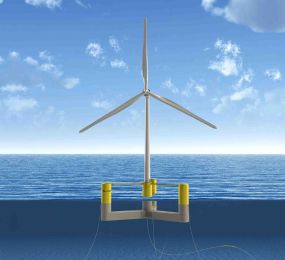
Around 80 percent of global offshore wind resources sit in waters deeper than 60 metres — beyond the reach of fixed-bottom foundations. Floating wind turbines, anchored by mooring lines, are the only technology built to capture that potential.
For Europe, this unlocks the Atlantic coasts of Portugal, Spain, and Ireland; the deep waters off Scotland and Norway; and the Mediterranean shelf — resources that have remained untapped until now.
The EU targets at least 60 GW of offshore wind by 2030 and 300 GW by 2050. Floating Wind carries a growing share of that ambition. By the end of 2024, total global floating capacity stood at around 278 MW — a number set to scale rapidly as commercial projects move into construction.
The 80 percent opportunity is no longer theoretical. Europe is building for it.
Hywind Tampen, Norway: The World's Largest in Operation
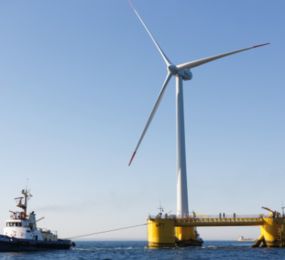
Equinor's Hywind Tampen opened in August 2023 and holds the title of the world's largest operational floating offshore wind farm, sitting 140 km off the Norwegian coast.
- Capacity: 94.6 MW across 11 turbines
- Purpose: World's first floating wind farm to power offshore oil and gas platforms
- Investment: Approximately NOK 7.4 billion
- CO? impact: Reduces emissions by around 200,000 tonnes per year
- Cost reduction: 35% lower per installed MW than the earlier Hywind Scotland pilot
Hywind Tampen also serves as a test bed for next-generation turbines and mooring systems, feeding learnings into future projects across Floating wind Europe and beyond.
Provence Grand Large and France's Mediterranean Pipeline
In 2025, EDF Power Solutions and Maple Power commissioned Provence Grand Large, France's first floating wind farm, a 25 MW Mediterranean pilot. It validated key supply chain and technology assumptions for larger projects to follow.
Next in line is Méditerranée Grand Large, awarded in December 2024, targeting 250 MW and capable of powering around 450,000 homes. France's upcoming tenth tender round targets up to 10 GW, including three dedicated floating wind projects, confirming the Mediterranean as a growing floating wind zone.
Ossian, Scotland: The Commercial Giant in Development
Ossian, a joint venture between SSE Renewables, CIP, and Marubeni Corporation, is one of the most ambitious projects in the global pipeline.
- Planned capacity: Up to 3.6 GW
- Location: 84 km off Scotland's east coast, at 72 m average water depth
- Projected output: Powers approximately 6 million homes; offsets 7.5 million tonnes of CO? per year
- Progress: Two years of wind data collection completed in 2025; first power targeted before the end of the decade
Celtic Sea: The UK's Floating Wind Zone
The Crown Estate awarded three Celtic Sea sites in 2025, each up to 1.5 GW, going to Equinor, Gwynt Glas (EDF Renewables UK and ESB), and Ocean Winds (EDPR and ENGIE). Together they represent up to 4.5 GW of capacity. Supporting this, the Port of Cromarty Firth received £55 million from the UK's FLOWMIS programme, and a further 4 to 10 GW is expected to come to market in the Celtic Sea by 2030.
Utsira Nord, Norway: The Next Chapter
In May 2025, Norway launched a tender for three project areas within the Utsira Nord zone, each supporting up to 500 MW, with a total long-term potential of 6 GW. By December 2025, project areas went to Equinor Utsira Nord AS and Vårgrønn Utsira Nord AS. The Norwegian Parliament approved state aid of up to NOK 35 billion to back the programme.
Investment Trends: The Money Is Moving
Capital is flowing into floating wind at scale:
- Europe's offshore wind sector drew a record €18.6 billion in 2024
- The European Commission committed €11 billion in CfD support for French floating wind projects
- Portugal approved four Atlantic areas for deployment ahead of its first auction
- Spain and Italy are advancing their first tenders
Cost reduction remains the central challenge, but Hywind Tampen proved that per-MW costs fall with experience. The direction of travel is clear.
Floating Wind, Green Fuels, and the Future of Shipping
The story of floating wind extends well beyond the electricity grid. Floating wind generates renewable power that producers convert into green hydrogen through electrolysis. That hydrogen then becomes green ammonia or e-methanol, the zero-carbon fuels the shipping sector needs to meet the IMO's 2050 decarbonisation targets. Floating wind Europe projects are increasingly positioned as a primary energy source for this supply chain.
Leadvent Group, one of the world's leading B2B event management companies, brings this conversation to life through focused, high-impact conferences across the renewable energy and maritime sectors.
Their 6th Annual Floating Wind Europe takes place on 23 and 24 June 2026 at the Radisson Blu Hotel, London Heathrow, United Kingdom. The event connects 150+ floating wind experts and features 35+ speakers from organisations including DNV, Aker Solutions, Ramboll, KfW IPEX-Bank, HSBC, Vårgrønn, and the Scottish Government, covering topics from project financing and supply chain readiness to mooring systems and O&M strategy.
If floating wind is a priority for your organisation, this is the Floating wind conference to attend. Register here: 6th Annual Floating Wind Europe
Frequently Asked Questions (FAQs)
- What makes floating wind different from conventional offshore wind?
Floating turbines sit on moored platforms rather than fixed foundations, allowing deployment in waters beyond 60 metres depth. Around 80% of global offshore wind resources lie in those deeper waters.
- Which European country leads in floating wind today?
Norway leads on operational capacity with Hywind Scotland (2017) and Hywind Tampen, the world's largest at 94.6 MW (2023). The UK holds the largest development pipeline through its Celtic Sea and ScotWind programmes.
- How does floating wind connect to sustainable marine fuels?
Floating wind powers electrolysis to produce green hydrogen, which converts into green ammonia or e-methanol. Both are zero-carbon fuels that commercial shipping needs to meet its 2050 decarbonisation targets.
- What investment is flowing into European floating wind?
Europe's offshore wind sector attracted a record €18.6 billion in 2024. The EU backed French floating wind projects with €11 billion in CfD support. Norway committed NOK 35 billion in state aid for Utsira Nord. Major developers across the UK, France, and Norway are driving gigawatt-scale projects forward.




Comment