

Is Floating Solar the Future of Solar PV? Here Is What You Need to Know
Developers, utilities, and policymakers are racing to scale up clean generation. One question now sits at the centre of that push: should new solar capacity go on land, or on water?
The debate between ground-mounted Solar PV and water-based systems is no longer theoretical. It shapes project economics, land use, and grid resilience for decades to come.
Understanding the Two Technologies
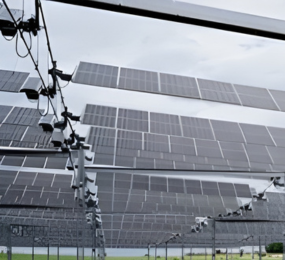
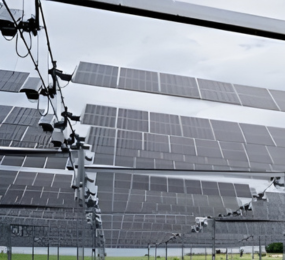
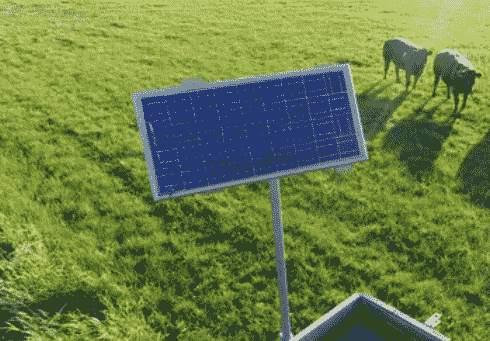
Traditional ground-mounted solar is the backbone of the modern solar industry. Workers secure panels to metal frames fixed into the earth at a fixed tilt or on sun-tracking systems. The technology is mature, widely deployed, and well-supported by global supply chains. Its main constraint is land — installations typically require 3.5 to 16.5 acres per megawatt, putting projects in direct competition with agriculture and urban development.
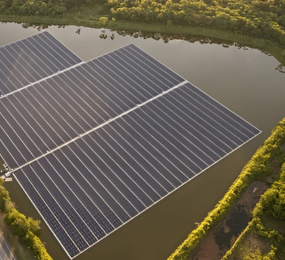
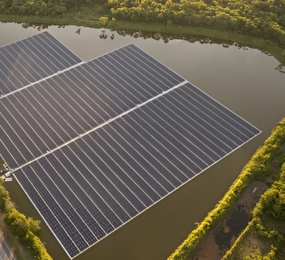
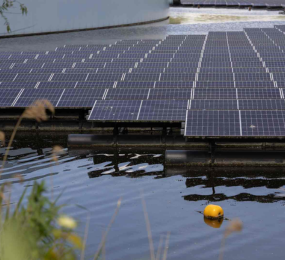
A floating solar panel system, also known as a floating photovoltaic (FPV) installation, uses the same photovoltaic modules but mounts them on buoyant HDPE pontoon structures on water. Key design elements include:
- Anchoring systems that adapt to fluctuating water levels
- Bifacial panels that capture both direct and water-reflected sunlight
- Mooring cables engineered to handle wind loads and reservoir level changes
Does Water Actually Improve Performance?
Yes, and the science is consistent. Photovoltaic cells lose efficiency as temperatures rise. Water provides natural evaporative cooling, keeping floating panels 10 to 15°C cooler than ground-mounted equivalents. The results speak clearly:
- Floating systems deliver 5 to 15% higher energy yields in typical conditions
- Research across four Indian locations found floating arrays produced 6 to 7% more power than land-based systems
- In tropical climates, gains of up to 15.5% have been recorded
Bifacial panels, standard on most floating deployments, add further output by capturing light reflected off the water surface below.
Land, Water, and the Market Opportunity
Ground-mounted Solar PV projects frequently face community resistance over agricultural displacement. Floating systems sidestep this by using reservoirs, hydropower lakes, and irrigation ponds that would otherwise sit idle.
The numbers reflect the growing momentum:
- The World Bank estimates that globally deployable floating solar capacity could reach 400 GW
- The global market stands at USD 1.06 billion in 2025 and is forecast to surpass USD 3.38 billion by 2030
Floating solar panel installations also reduce water evaporation by up to 70% and suppress algae blooms — a practical co-benefit in water-stressed regions.
Cost and Economics
Ground-mounted systems carry lower upfront costs. There are no floating platforms, specialised mooring, or marine-grade components to factor in. However, floating solar becomes competitive across the full lifecycle when co-benefits are included:
- Avoided land costs of $50,000 to $200,000 per MW, depending on location
- Energy yield premium of 5 to 15%, adding revenue over the system's life
- Water conservation value of $10,000 to $50,000 per MW annually
- Lower maintenance costs from reduced dust accumulation
Projects co-located with hydropower infrastructure often achieve the strongest economics, sharing transmission connections and technical resources.
Key Challenges to Consider
Floating solar requires careful planning. Developers and investors should weigh:
- Higher upfront capex from platforms, anchoring, and marine-grade components
- Maintenance complexity: specialist personnel and watercraft add operational overhead
- Environmental assessments: effects on aquatic ecosystems require site-by-site evaluation
- Financing barriers: insurance frameworks and regulatory pathways are still maturing in many markets
Standardisation efforts and growing operational data from commercial-scale projects are steadily reducing these barriers.
Which Technology Fits Your Project?
Ground-mounted solar works best where flat land is available at a competitive cost, permitting is straightforward, and upfront economics are the priority.
Floating solar makes the stronger case where land is scarce or contested, water bodies sit near grid connection points, and water conservation is a shared objective.
Offshore and coastal installations are the sector's next frontier, with commercial-scale projects now proving viability in open-sea conditions across Europe and Asia.
Be Part of the Conversation: 6th Annual Floating Solar PV Forum
Floating solar is no longer a niche technology. It is a commercial reality attracting serious investment, policy attention, and engineering innovation. The professionals driving that shift will be in one room this May.
Leadvent Group has spent nearly a decade convening the energy transition's most important conversations. This year, its flagship floating solar event returns as the 6th Annual Floating Solar PV Forum, bringing together 35+ expert speakers and 150+ industry peers for two focused days in Amsterdam.
Attendees will hear directly from specialists at DNV, Fraunhofer ISE, ING Bank, Oceans of Energy, TNO, and Lightsource bp, among others. Sessions cover the topics that matter most right now:
- Bankability and project financing
- Next-generation mooring and anchoring systems
- Offshore wind and floating solar hybrid models
- Environmental impact and water ecosystem management
- Market outlook and supply chain readiness
The forum takes place on 6th and 7th May 2026 at the Steigenberger Airport Hotel in Amsterdam, the Netherlands.
Frequently Asked Questions (FAQs)
- Are floating solar panels less efficient than ground-mounted systems?
No. Water cooling keeps panels 10 to 15°C cooler, and floating solar panel systems consistently produce 5 to 15% more energy than ground-mounted equivalents. The advantage is strongest in hot and tropical climates.
- Are floating installations more expensive than traditional solar farms?
Upfront costs are higher, but avoided land costs, higher yield, and water conservation benefits close the gap significantly over the full project lifecycle.
- What water bodies are suitable for floating solar?
Man-made reservoirs, irrigation ponds, water treatment facilities, and hydropower lakes are the most common sites. Offshore deployments are advancing rapidly, with wave and corrosion engineering now proven at commercial scale.
- Does floating solar harm aquatic ecosystems?
Research is ongoing and forms a core part of discussions at Leadvent Group's annual floating solar event. Panels reduce evaporation and limit algae growth, while potential effects on temperature stratification and biodiversity require site-specific assessment and monitoring.




Comment