

Sustainable Aviation Fuels and E-Fuels: Addressing Aviation and Shipping Industry Challenges
In today’s world of globalization, every day, thousands of cargo ships cross our oceans, and in the same way, our skies are covered by airplanes. Together, these transportation giants move the goods and people that keep our global economy running, but they also contribute to global carbon emissions.
Now, if we can fuel these gigantic machines and industries, and can they be run virtually carbon-neutral, then? Enter Sustainable Aviation Fuels (SAFs) and e-fuels, the power of long-distance transport.
Events like Leadvent Group's 2nd Annual World e-Fuels Summit 2025 are crucial in bringing together the minds and technologies where they can raise: How do we scale production? How do we bring costs down? And most importantly, how do we do it fast enough to meet our climate goals?
The Current Landscape: Where We Stand Today
Unlike cars or even trains, electrifying a massive cargo ship or a long-haul passenger jet isn't simply a matter of plugging in.
Even though there have been advancements in the sector of “green” fuels, numbers do tell a different story altogether. According to the International Air Transport Association (IATA), despite years of investment and advancement of sustainable aviation fuels (SAF) only represent 0.3% of global jet fuel production in 2024. The reason is quite simple: a much higher price tag rather than conventional jet fuel.
The unknown factor in this equation comes from e-fuels. Power-to-liquid technologies show fast progress because green hydrogen functions as their essential foundation.
The challenge? Most production facilities remain concentrated in a handful of regions, and current output barely scratches the surface of what these industries need.
Sustainable Aviation Fuels (SAFs): The Immediate Impact
What are SAFs?
Sustainable Aviation Fuels (SAFs) aren't entirely new inventions, rather alternatives from diverse sources like used cooking oil, agricultural waste, and even municipal solid waste.
Key Advantage:
The benefit of using SAFs is their “drop-in” capability, which simply means they can be blended with traditional jet fuel and used on aircraft without making any additional infrastructure modifications.
The compatibility makes it a true champion, while its quick adoption can create a great impact. The production of SAFs through efficient feedstock management and optimized manufacturing systems enables an 80% reduction in greenhouse gas emissions in comparison to conventional fossil fuel usage.
Overcoming Hurdles:
One of the primary hurdles that arise is scaling production. Securing enough sustainable feedstock and expanding refining capacity globally are major challenges.
SAFs face a significant cost challenge because their prices remain elevated. The achievement of equal pricing between SAFs and traditional fuels depends on continuous policy aid together with financial support and technological advancements that minimize manufacturing expenses.
E-Fuels: The Long-Term Game-Changer for True Carbon Neutrality
What are E-Fuels?
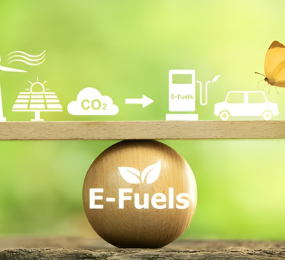
Synthetic fuels created not from biomass, but from thin air – or rather, from renewable electricity, water, and captured carbon dioxide.
Key Advantage:
E-fuels represent the potential of "Power-to-X" technologies through which green electricity surplus transforms into liquid or gaseous fuel products. The fuel operates within an almost closed carbon cycle because it releases the exact amount of CO2 it absorbed during combustion.
Another advantage of e-fuels is their incredible scalability and resource independence. How? The answer is simple: they can be produced wherever renewable energy is abundant, freeing us from reliance on specific agricultural lands or waste streams.
Hurdles:
This groundbreaking technology comes with it’s own set of hurdles. Prime one is the energy intensity, generating e-fuels requires a huge amount of renewable electricity, causing high production costs.
The implementation requires substantial technological progress together with economic feasibility. Constructing the essential infrastructure for mass e-fuel production alongside storage and distribution across the world stands as a massive challenge that demands both extensive funding and coordinated efforts.
Solutions: Bridging the Gap
Complementary Roles:
- Sustainable Aviation Fuels (SAFs) provide a concrete and actionable solution which allows the reduction of both aviation and shipping emissions starting now.
- The future of propulsion depends on e-fuels because they represent the genuine carbon-neutral solution for the long term.
Accelerating Progress Requires:
- Innovation & Investment: Crucial for driving down costs and boosting efficiency across both fuel types.
- Supportive Policy: Governments need to provide unambiguous directives and monetary support together with practical carbon pricing systems to drive both adoption and production.
- The widespread e-fuel production needs carbon capture technology together with CO2 utilization and storage systems to generate essential CO2 feedstock.
- The development of strong sustainable partnerships between energy companies and technology developers and airlines and shipping giants requires vital collaboration between different industries.
The Role of the 2nd Annual World e-Fuels Summit 2025
The massive task of aviation and shipping decarbonization requires teamwork from both companies and countries because it cannot be addressed independently by any single entity. It demands collective action.
Leadvent Group's 2nd Annual World e-Fuels Summit exists because events like these play a crucial role in bringing industry leaders together. These crucial meetings bring together industry leaders and forward-thinking policymakers and innovative minds who develop critical partnerships which accelerate sustainable solution implementation.
Frequently Asked Questions (FAQs)
1) What are the biggest challenges facing the widespread adoption of SAFs and e-fuels?
The main obstacles prevent wide-scale adoption of Sustainable Aviation Fuels (SAFs) and e-fuels because production must expand to match demand while prices need to reach traditional fuel levels and SAF production needs steady sustainable feedstock sources and e-fuel manufacturing and distribution systems must be developed.
2) How will the 2nd Annual World e-Fuels Summit address these challenges and opportunities?
The summit exists to create a collaborative environment by uniting industry leaders with policymakers and innovators. The summit will present Power-to-X technology advancements together with production scale-up methods and regulatory approaches, and investment possibilities, and case study analysis to speed up e-fuel development and deployment.











Comment