

Why Supply Chain Resilience Is Now a Business Imperative
Global supply chains face more simultaneous threats today than at any point in recent history. Geopolitical shifts, extreme weather, and cyberattacks no longer occur in isolation. They overlap, interact, and amplify each other. Businesses that rely on outdated frameworks are not just unprepared; they are exposed.
The good news? The right strategies exist. The gap between resilient businesses and vulnerable ones comes down to whether those strategies are actually in place.
The Risks That No One Can Ignore Anymore
The threat landscape has shifted far beyond delayed shipments or a supplier going under.
Geopolitical volatility is now a core variable in supply chain design. Tariffs, trade sanctions, and export controls affected over 80% of global supply chain organisations in 2025, according to McKinsey research. The question is no longer if geopolitics will affect sourcing. It's how much, and how fast.
Climate disruption has moved from a background concern to frontline operational reality. Billion-dollar weather disasters now occur every three weeks, four times more frequently than in the 1980s. Droughts affecting the Rhine, Danube, and Panama Canal have permanently altered key shipping routes.
Cyber threats have evolved from an IT issue into a full supply chain crisis. A single attack on an airline technology provider in late 2025 cascaded through European airports, halting cargo and disrupting procurement simultaneously. The impact of a breach now extends far beyond the initial point of entry.
These risks don't arrive separately. They compound. That's what makes them so difficult to manage without a clear strategy.
Strategies That Actually Work
Map Your Supply Chain Before You Need To
Most businesses know their Tier 1 suppliers well. Tier 2 and Tier 3 are often murky. That's where hidden vulnerabilities live.
Supply chain mapping builds a transparent picture of every node and dependency. It is the foundational step before any other risk strategy can take effect.
- Identify critical suppliers across all tiers
- Flag single points of failure in your network
- Establish monitoring protocols for high-risk nodes
Diversify, But Do It Deliberately
Supply chain diversification isn't new, but the logic behind it has evolved. It's no longer about having a backup supplier. It's about building multi-node regional networks that balance efficiency with resilience.
In practical terms:
- Near-shore intentionally for critical categories
- Dual-source components that carry high disruption risk
- Maintain strategic inventory buffers where lead times are long
The goal is agility under pressure, not redundancy for its own sake.
Make Scenario Planning a Continuous Practice
Scenario planning has long been treated as a once-a-year boardroom exercise. Resilient businesses have made it an ongoing discipline. They run live simulations, stress-test assumptions, and update plans as new intelligence comes in.
Marsh describes this as multi-faceted risk modelling: testing disruption scenarios in terms of damages, downtime, and revenue loss. Not just checking a box.
Use Technology Wisely
AI and digital twins now enable real-time visibility and smarter decision-making across supply chains. Demand-sensing models factor in weather patterns and macroeconomic signals. Automated tools monitor vendor risk for ESG and geopolitical exposures.
The most effective application of AI is augmenting human judgment, not replacing it. Use technology to sharpen decisions. People still need to make them.
Treat Supplier Relationships as a Risk Asset
Businesses with strong supplier relationships consistently fare better when disruption hits. Partnerships built on transparency, shared forecasting, and mutual continuity planning create resilience that contracts alone cannot guarantee.
Visibility into Tier 2 and Tier 3 suppliers has become a genuine competitive differentiator in risk preparedness.
The Market Is Telling You Something
The global Supply Chain Risk Management market is projected to grow from $4.52 billion in 2025 to $9.22 billion by 2030. Businesses across every sector are investing in this capability because the cost of not doing so keeps rising.
The shift is clear: from cost-optimisation to resilience as strategy. Businesses that made that pivot early are already seeing results in operational continuity and margin protection.
Where Industry Leaders Come to Get Ahead
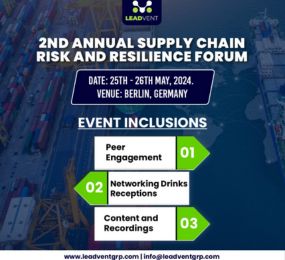
Leadvent Group's 3rd Annual Supply Chain Risk and Resilience Forum takes place on 10–11 June 2026 at the Steigenberger Airport Hotel, Amsterdam, Netherlands.
This is the definitive Supply Chain Risk Event for professionals who need more than theory. The previous edition drew over 140 senior professionals. This year's Supply Chain Forum brings together the decision-makers who are actively shaping how organisations prepare, respond, and recover.
The forum is built for:
- Chief Supply Chain Officers and Heads of Procurement
- Risk Directors and Operations Leaders
- Logistics Heads and Supply Chain Strategists
Discussions cover geopolitical risk response, supplier diversification, technology adoption, and real-world crisis management. Leadvent Group has been producing industry-leading B2B conferences across Europe since 2011, known for focused agendas, senior speakers, and high-value networking.
Seats are limited. Secure your place at the 3rd Annual Supply Chain Risk and Resilience Forum before they fill up and walk away with strategies your competitors are still searching for.
Frequently Asked Questions
- What is Supply Chain Risk Management, and why does it matter more now?
Supply Chain Risk Management is the practice of identifying, assessing, and mitigating threats that disrupt the flow of goods, services, and information across a supply chain. Geopolitical tensions, climate events, and cyberattacks now hit simultaneously. Businesses that treat risk management as a strategic function maintain continuity and protect margins far more effectively than those treating it as a reactive measure.
- How can a business build supply chain resilience without overhauling everything at once?
Start with visibility. Map your supply chain down to at least Tier 2 suppliers and identify your highest-risk nodes. Then prioritise diversification in your most vulnerable procurement categories. Build scenario plans for the top three to five disruptions most likely to affect your business. Resilience comes from consistent, informed decisions over time.
- What role does technology play in modern supply chain risk management?
Technology plays a central and growing role. AI-powered tools flag supplier vulnerabilities and sense demand shifts before they become crises. Digital twins allow businesses to simulate disruptions before they happen in real life. The key is pairing strong analytical tools with experienced professionals who can act on the insights.
- Who should attend the 3rd Annual Supply Chain Risk and Resilience Forum?
The Supply Chain Risk Event is designed for senior professionals in supply chain strategy, procurement, operations, and risk. This includes CSCOs, CPOs, Risk Directors, Logistics Heads, and Operations Executives. Attendees gain peer-led case studies, practical frameworks, and a high-quality network of like-minded leaders across industries.









Comment