

Case Studies of Successful AgriVoltaic Farms in Europe
As the European Union strives for climate neutrality, the competition for land between agriculture and energy production has intensified. AgriVoltaics (APV)—the simultaneous use of land for solar energy and farming—has emerged as a transformative solution. Several landmark case studies across Germany, the Netherlands, and France demonstrate that this synergy not only preserves agricultural land but can actually enhance crop resilience and overall land productivity.
The Arable Pioneer: Heggelbach, Germany
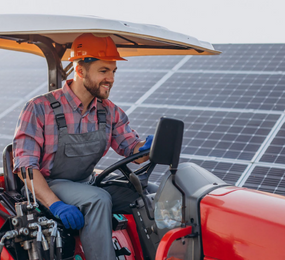
The Heggelbach project is widely considered the gold standard for arable AgriVoltaics. Utilizing an elevated 5-meter structure, the farm allows standard tractors to cultivate winter wheat and potatoes beneath 194 kWp of bifacial solar modules. During the unusually hot summer of 2018, the project recorded a Land Use Efficiency (LUE) of 186%. The panels provided a cooling effect and shaded the soil, resulting in an 11% increase in potato yields compared to traditional plots, proving that solar infrastructure can act as a protective shield against climate extremes.
Specialty Crop Success: Babberich, Netherlands
In the Netherlands, the Babberich farm transitioned from traditional plastic "foil tunnels" to semi-transparent solar modules for raspberry cultivation. This 2.67 MWp installation solved two problems simultaneously: it eliminated the need for single-use plastic waste and created a more stable microclimate. The raspberries grown under the panels showed improved color and size consistency, as the modules mitigated the scorching effects of direct UV radiation and stabilized temperatures during heatwaves.
Innovation in Motion: Amance, France
The Amance project highlights the future of "smart" AgriVoltaics. Utilizing the "Tse-bo" tracking system, the solar panels adjust their tilt based on real-time plant growth stages and sunlight requirements. With wide spans exceeding 10 meters, the site accommodates high-clearance machinery for wheat and rapeseed. The AI-driven algorithm ensures that the energy-agriculture trade-off is optimized, providing shade only when the crops benefit from reduced evapotranspiration.
These European case studies prove that AgriVoltaics is no longer a theoretical concept but a scalable reality. By moving from fixed structures to intelligent, crop-specific designs, the EU is securing both energy independence and food security on the same hectare of land.
Visit our website to know more: https://www.leadventgrp.com/events/4th-annual-agrivoltaics-europe/details
For more information and group participation, contact us: [email protected]
Leadvent Group - Industry Leading Events for Business Leaders!
www.leadventgrp.com [email protected]





Comment